

Having One's Cake
On recipe boxes as family archives, and the imagination of yearning

i.
The book we’ve been listening to mentioned cake. Only in passing, true; but in that way some British novels have (especially when read aloud by a British actor old enough to have been cruelly deprived of cake during the Austerity years) of making you question whether any reference to something so vital to human happiness as cake can really be said to be “only in passing.”
Anyway, when I came downstairs to see about dinner, I found myself unable to rid myself of the idea that a nice piece of cake might be just the thing. And I knew, to my core, that if I were jonesing this hard for cake, my wife must be in a very bad way, indeed. But the neighborhood bakeries had all closed by now, and outside it was pouring down rain, and though the exact nature of the cake whose surprise appearance had just been applauded by the characters in our book had been left to the imagination— “chocolate” was the lone detail provided—the imagination was pretty sure that it had not been Doordashed from Safeway, in a polyethylene clamshell.
The imagination and I reviewed the available alternatives. I could bake a nice layer cake—a “sandwich,” as they were known on the British baking show—but I knew from experience that even the most powerful yearning for a piece of cake rarely survives the time needed to bake one from start to finish, cooling times and all. Also: no matter what kind of cake I decided on, I knew, I was likely to be missing or running low on some needed ingredient or other: pecans, say, or dutch-process cocoa.
Cake mix? suggested the imagination, a little plaintively.
Now, I am not a mix-cake snob—far from it. Mr. Duncan Hines and I are old friends, and I will never say no to a slice of the man’s basic Yellow (though I will have no truck with his frosting, the kind that comes in a tub and can be used, in a pinch, to lubricate the rails of a rocket launcher). I have known the arcane thrill of practicing that essential trick of twentieth-century industrial food alchemy, immortalized in the lyrics to Steely Dan’s “Kid Charlemagne,” of adding pudding mix to the cake mix.
The problem with taking the cake mix route tonight was that, as a quick check of the pantry confirmed, there would definitely be an ingredient missing: cake mix. (There was no pudding mix, either, for that matter.) But I had flour, sugar, salt, unsweetened cocoa, and baking soda. I had vanilla extract, and white vinegar. I did not have any vegetable oil, but I did have a jar of coconut oil. That would do nicely, I thought.
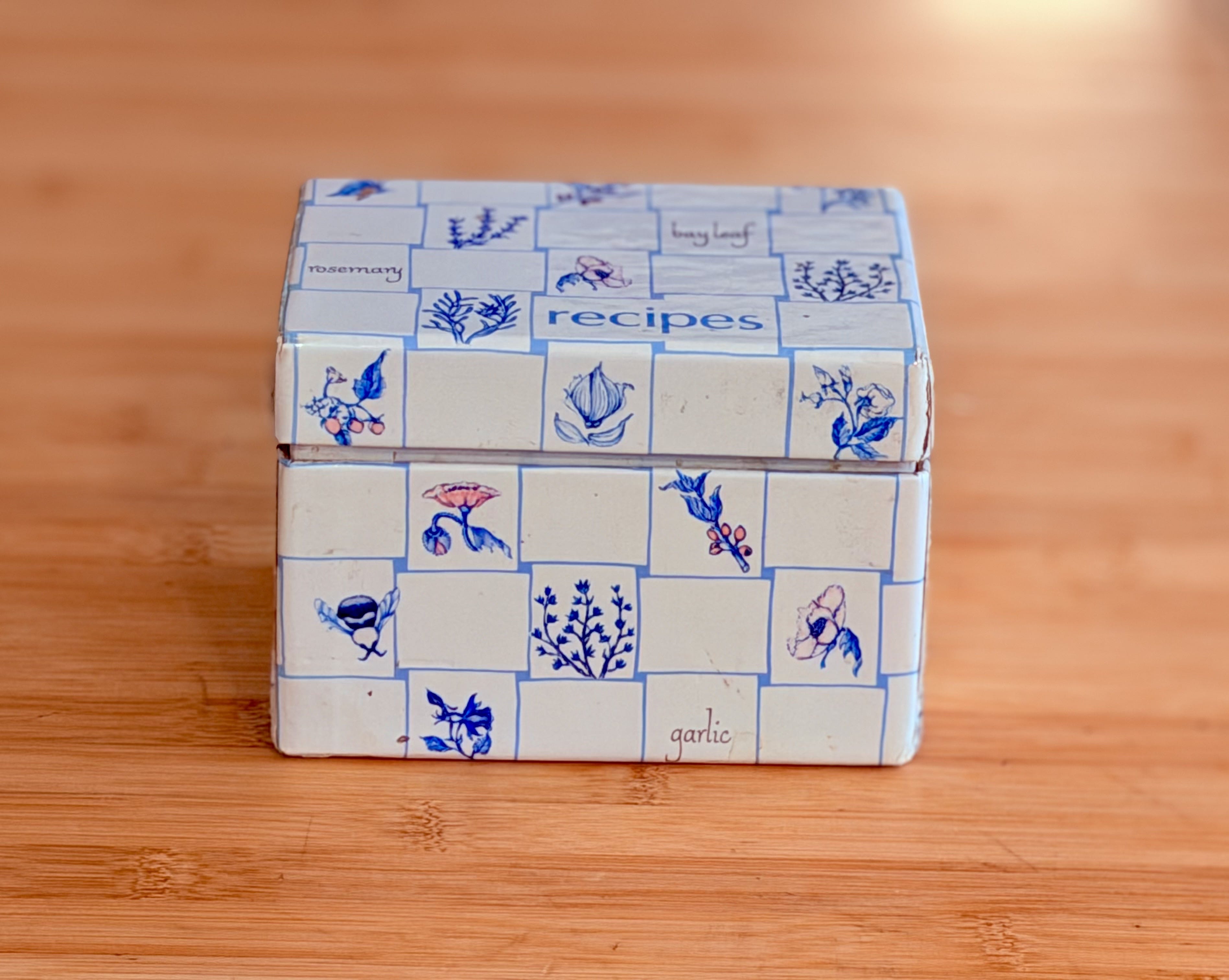
So I got out my recipe box.
ii.
Thirty years ago, just as I was beginning to grapple with the nightly challenge of presenting an interesting and compelling bill of fare to an ever-increasing party of small humans, my mother furnished me with a recipe box.
It was the same basic size and shape as the one I’d grown up with, in her kitchen—a key “textbook” in my education as a cook. In addition to a set of blank recipe cards and dividers, she had stocked this new box with a selection of those recipes that were “hers,” the ones that, she remembered, had always been my favorites.
No one really “owns” a recipe, of course, and the two dozen or so that my mother painstakingly wrote out on thin blue cardstock, in her loopy cursive, had been acquired or inherited from her own mother, from a small cadre of aunts (Aunt Margie, Aunt Vivian) who were the celebrated cooks in our family, from friends and neighbors, from newspapers, cookbooks, and women’s (and before that, ladies’) magazines.1
Most of them however, she had refined, simplified, or improved on, often parenthetically noting her changes, as in the recipe for “Chicken Rosé,” a dish served to her by a friend at a dinner party in the early 1970s, when vin rosé (and in particular, Mateus) was having its first North American vogue. “Chicken Rosé” (my first experience, though I lacked any such vocabulary, of what we would now call a complex flavor profile) was immediately promoted to my mother’s standard repertoire , as a “fancy” dish to be served when we were “having company.” Over the years, as she duly noted on the card, she began to cook with olive oil where before she had contented herself with the generic “shortening,” and learned to substitute fresh garlic for garlic salt.


What impressed me most about “Chicken Rosé,” however, at the time and forever after, was my mother’s astonishment on the morning after the dinner party as she reported that this savory dish had been cooked, and served, by the husband. Her admiration for this anomalous, magical man made such a powerful impression on my eight-year-old mind that although I met him only once, and briefly, I have never forgotten his name: Frank Testa, an early object lesson in my lifelong course of study into the subject of How to Be a Good Husband.
Other recipes in the box were conferred without alteration, either because they were perfect as they were, or because they depended on some particular thermo-chemical process for success and thus must be transmitted, and followed, to the letter.
In that latter category—food as science fair experiment—was the recipe for what my mother (mistakenly, as it turns out) has always called “Lazy Day Cake.”
iii.
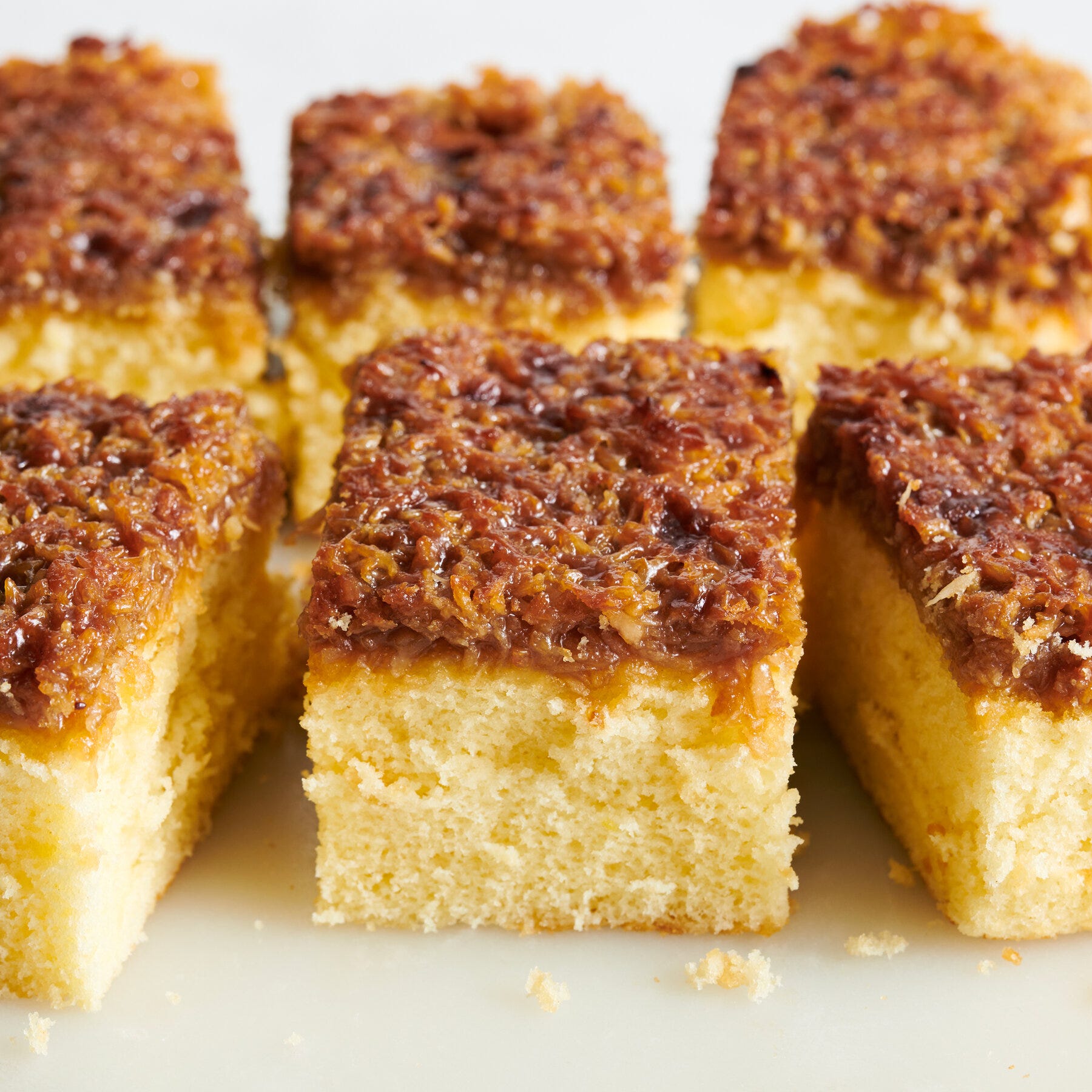
A “Lazy Day (or more commonly Lazy Daisy) Cake,” it turns out, is and has always been something else entirely. The New York Times’s Melissa Clark recently presented a version. It’s a good, simple, yellow sheet-pan cake with a topping of brown sugar and coconut that you stick under the broiler until it puffs up and acquires a chewy toothsomeness. It clearly belongs among the coffee cakes, something that can quickly be thrown together for mid-morning or mid-afternoon visitors, a cousin to Streusel Cake and Crumb Cake.2 It earned its sobriquet, apparently, because of the perceived “laziness” of stirring some brown sugar, salt, milk, and shredded coconut into some melted butter and dumping them over the finished cake to let the broiler do its thing, when there were proper frostings to be boiled and whipped.
The cake that I was now determined to make, standing there in my understocked kitchen in a mild panic of yearning, is something darker, trickier, more notorious, known like a cryptozoid or legendary bandit by a variety of romantic epithets and aliases, each of them evocative in its own way: “Wacky Cake,” “Wonder Cake,” “Depression Cake” or “Chocolate Depression Cake,” “War Cake,” even “Poor Man’s Cake.” In the online accounts and histories there is a good deal of speculation and unattributed statement presented as fact, and one senses that one is dealing less with any particular, specific recipe than with a particular category, or conception, of baked good: a cake that can be made when, for whatever reason, fresh eggs, milk and, in its grimmest-sounding incarnations, even sugar, are in short supply.
iv.
Here is a faithful transcription (quirky notations, margarine, and all) of my mother’s version of what she has always called a “Lazy Day Cake”—I hope and trust that she will feel free to carry on doing so.


Lazy Day Cake
Sift together into 8 x 8 x 2 cake pan
1 1/2 C flour
3 heaping TLB cocoa
1 tsp baking soda
1 tsp salt
1 cup sugar
Make 3 holes in mixture
① In hole 1 — 1 tsp vanilla
② In hole 2 — 1 TLB vinegar
③ In hole 3 — 5 TLB corn oil
Over all pour one cup cool water. Mix with fork. Bake at 350° 30-35 min
Icing
1 cup sifted confectioners sugar
1 TLB melted margarine
—a little milk to proper consistency
pour over cake while hot


In its egglessness and milklessness, its air of the makeshift or impromptu, this cake clearly conforms to the “Depression” or “War Cake” typology, but I’m skeptical about any claims as to its authentic heritage as the product of wartime rationing or poverty. A cake that leans so heavily on a luxury item like cocoa seems unlikely to have originated in straitened circumstances, and it’s freely and liberally sweetened, thank God, with sugar (both granulated and powdered), not molasses, or (as some of the earliest Civil War-era recipes apparently recomended) some unholy maceration or syrup extracted from raisins, halfway to jailhouse hooch. “Wacky” or “Wonder” feel more appropriate, with the latter in particular suggesting one appeal of this recipe: that you make it all directly in the pan, which requires no greasing or other preparation; that it depends for leavening on a classic trick of chemistry-class magic: the interaction of baking soda and vinegar, complete with the charming bit of flummery or misdirection of the three (perfectly gratuitous, as far as I can tell) holes.
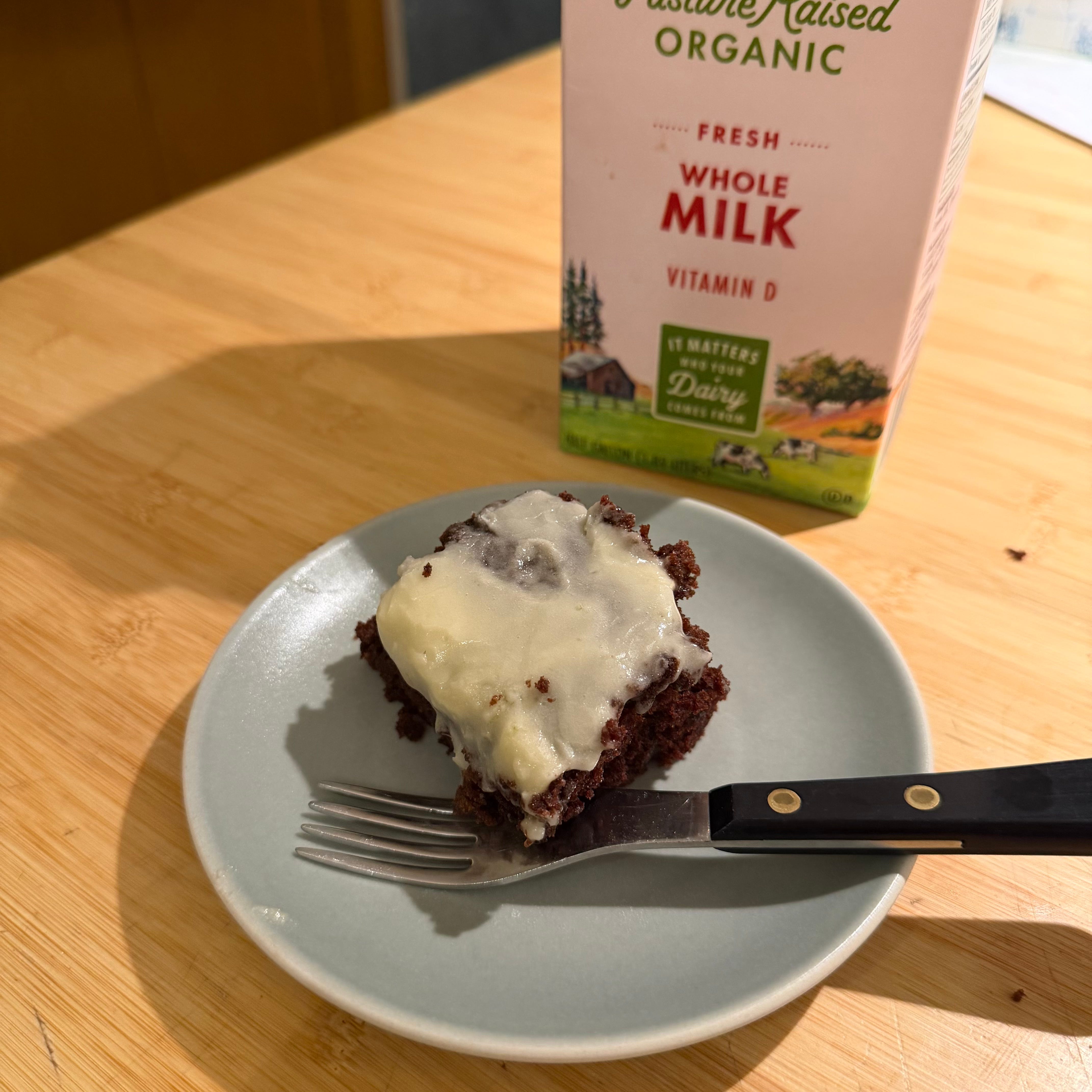
All that, and the fact that with its rich cocoa flavor, its unfailingly moist crumb, and especially when served fresh and still a little warm from the oven, with the milk-butter-sugar icing just set—it renders up a surprisingly good piece of cake, less than an hour after the onset of the first acute spasms of cake longing.
iv.
“Oh, my God, you’re making cake?” my wife said, when she came downstairs and saw what I was up to in the kitchen, speaking with a faint, unconscious trace of our audiobook narrator’s plummy accent. “I’ve been sitting up there desperate for cake! Googling cakes! You wonderful husband, how did you know?”
Wherever he may be, on earth or elsewhere, I sensed the hovering presence of Frank Testa, giving me the thumbs up.
About 10 years ago, my eldest daughter went through the recipe box, recopying her grandmother’s by-now tattered and torn entries and adding tabs, all in her perfect micrographic hand, and then preserving the originals in plastic sleeves.
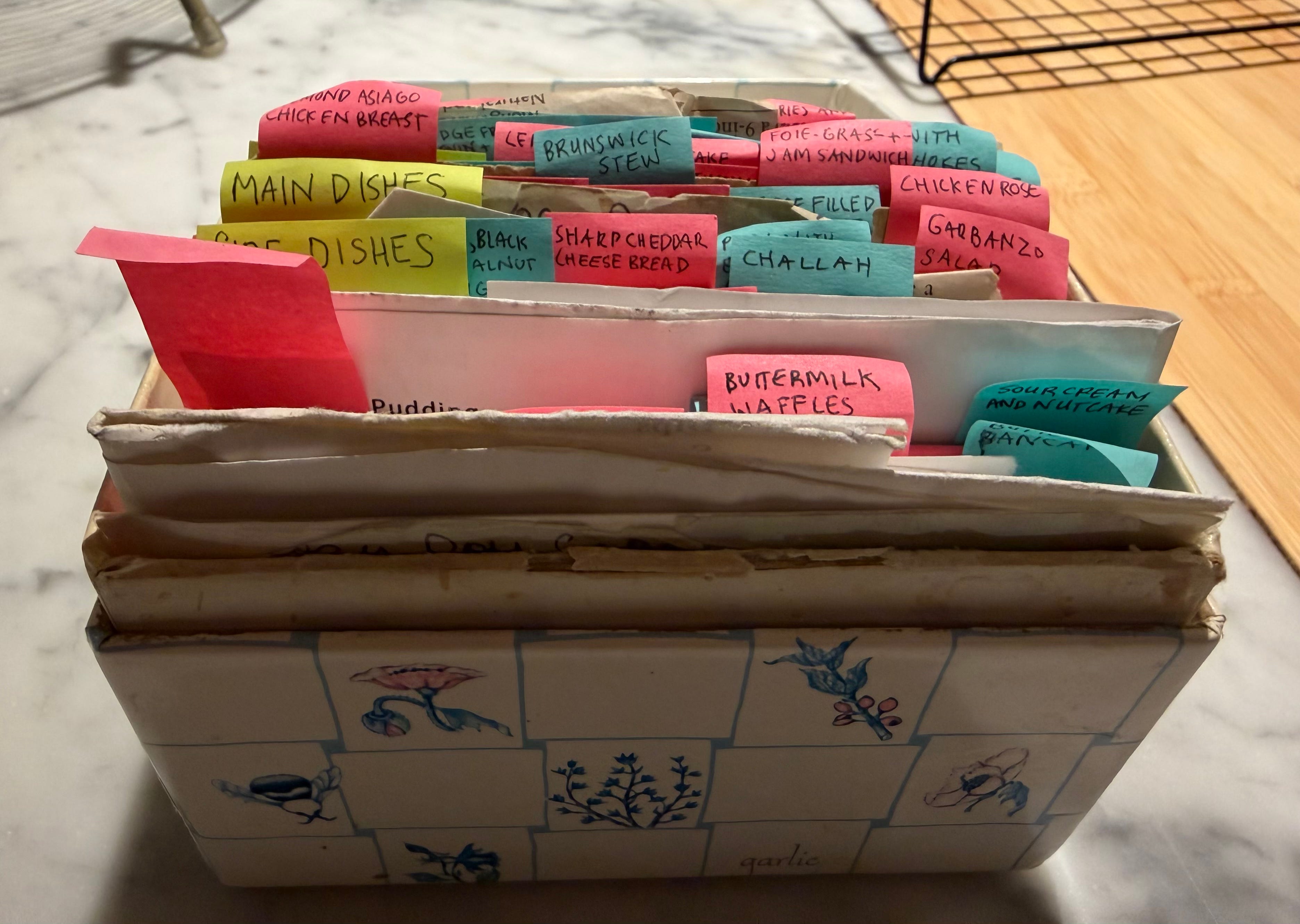
.
I’ve written elsewhere about the improbable pleasure of the Bisquik-based “Velvet Crumb Cake,” the first cake I ever baked myself, from scratch.
I have made this miraculous chocolate cake many times. I like making the little ingredient wells.
Well, that was almost impossibly delightful.