

Let’s Get It Started (But Not, Alas, Finished) in Here
42 years of abandonments, petering-outs, and fine starts that went nowhere

[Note: Even this list is incomplete.]
Though my father was killed for revealing the secret, Clem and I have decided to take advantage of his simple discovery, and have bought a zeppelin.
Untitled, short story, 1983. 1900 words.
I swear, I do, I’ve stopped believing that I arrived in infancy from another planet.
Untitled, short story, 1983. 773 words.
It wasn’t as if, as in an inferior novel, we had come to enjoy ourselves carelessly at the Lake House, only to find after our enchanted arrival that the weapons had been launched and the world was at an end, isolating us there until we degenerated into some unlikely primitive state and I should hit Max over the head with a tree branch for final savage possession of Sylvia.
Untitled, short story, 1983–84. 3191 words.
Lobel lived in such utter hatred of strangers that in the year 1902 alone he nearly strangled three uninvited visitors to his isolate house.
“Mad Tryst,” short story, 1984, 4305 words.
Nagao had married Tomoko the Artificial Woman; everything was his fault.
“Author of The Death of Japan,” short story, 1985. 2460 words.
The introduction of Time to an achronous planet always proves to be a highly photogenic thing: planetary volcanic suicide, vast blankets of flying deer, bug empires, global winds, the invention of hells and edens, ice ages, and, very rarely, an occasional first war or wedding of whatever tottering ganglia manage to evolve the necessary urges and tools—these and seven hundred and twenty-six million other fabulous outcomes had already been recorded elsewhere and consumed throughout the Independent Greater Moments with noisy piety and deep pleasure.
The Fell Planet, or, the Inadvertent Establishment of the Butterfly Evil Through the Holy Intercession of St. Noss, novel, 1986. 1372 words.
My life falls neatly into its many epochs only when considered in terms of the crowds with whom, over the years, I have run, the empires of gossip and solace that arose, flourished, and crumbled away, suddenly and completely; and at the long-vanished center of each of those epochs you will find, fragrant and hot, a laundromat.
Untitled, short story, 1987. 226 words.
After the last great battle the soldiers rode for home, a starveling cavalry astride ruined horses whose lungs, even at a walk, filled with an ominous rattle like that of bones in a leather bag.
Untitled, novel, 1987. 1148 words.
Those of us who spoke with Roger in the half hour he spent at his sister’s wedding noted that he’d grown gangly and affected a dour manner during his six months in Paris, that he spoke too carelessly, and that, at 22, he hadn’t the faintest idea of what he wanted to do with himself.
Fountain City, novel (first draft), late 1987. 150000+ words (final draft).
I had seen my wife in the garden, talking to the handsome young man, when I looked down on them from the balcony of our hotel room.
“Key West Story,” aka “Winthrop,” 1988. 3963 words.
I remember listening to the “Emperor” concerto one melancholy winter afternoon in Pittsburgh when it seemed to me, as I watched the helices of snow twisting outside the window, that Ludwig von Beethoven’s music, the winter sky, and my sadness—I was in love—were all formed of the same sparkling, nebulous, gray material.
Untitled, short story, 1989. 603 words.
The loss of his grandparents’ house and every alteration in their lives and furniture Nathan had borne with the self-conscious stoicism of his age, but their new condominium apartment, a linoleum-and-stucco, rattan-and-herculon, avocado-and-goldenrod two-bedroom in a walled retirement community on the barren outskirts of Pompano Beach, was as small and had as little discernible odor as their old house in Pikesville had been spacious and ripe with water damage, holidays, brisket of beef, and dogs, and the only smell was the faint sour tang of air-conditioning.
Untitled “Nathan Shapiro” story, 1990–91. 900 words.
Frank Mandelbaum, who for eleven straight nights, due to a terrific array of marital difficulties, had slept in the unlined bed of his Japanese pickup, and who was regarded by his fellow teachers at Schuyler Colfax High School as rapidly approaching basket-case status, had just finished his fourth cigarette and was about to light a fifth from its dwindling coal when he heard an alarum in the schoolyard, a cry, a gasp, the rough laughter of boys.
“Ruby,” 1991. Later reborn as “Werewolves in Their Youth.” 2942 words.
When he sold his father’s underwear-and-lingerie wholesaling company, Selig Personal after having given forty years to making it hale and profitable, Sam Selig found himself faced with the task of spending his money and living the remainder of his life.
The Gentleman Host, novel, 1993. Later the basis for my first spec screenplay. 8934 words.
I had been a Constant driver for a little over two and a half months when I was assigned to Bernard and Monroe.
“Chauffeur,” circa 1997. 6787 words.
“I have scorn for you,” said Adam, when he answered the telephone.
“Bachelors,” circa 1997. 1039 words.
In 1924, Harry Houdini came to Boston, not, as so often in the past, to be screwed into a giant iron milk can or chained like a lunatic to a cruel bed on the stage of the Keith, but to debunk a medium named Mrs. Le Roi Goddard Crandon.
Untitled, short story, 1998. 2038 words.
We were standing over our bicycles, straddling them, on the driveway of the Compton house, where I had come upon Teddy in the act of setting out to look for me in the vain and half-hearted hope, which I hopelessly shared, that in one another’s company we might find some kind of occupation or amusement in the boiling abyss of July.
“The Hit,” short story, 2002. 1414 words.
The brothers first encountered a land sloop on the night, late in the summer of 1876, that one hunted their father down.
The Martian Agent, novel, 2002. 12160 words.
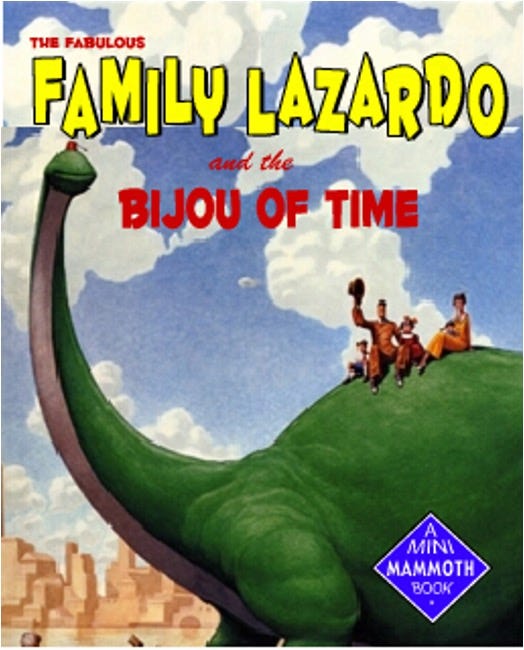
“Albert Einstein… Duke Ellington… Doc Savage… Cole Porter… Mrs. Roosevelt…” Mr. Lazardo said, gathering up the latest armful of telegrams and scattering them around the Lazardos spacious bedroom, “My dear, you are beloved! Positively beloved!”
The Fabulous Family Lazardo and the Bijou of Time, children’s novel, 2003. [Proposed “Big Little Book” homage, to have been illustrated by my friend William Joyce, creator of Dinosaur Bob and his adoptive family, the Lazardos.] 2800 words.
Three black figures struggle through falling black snow.
“Los Comprachicos,” short story, 2003. 2170 words.
In my family, the yearly colonization of Jews by Christmas produced a kind of pidgin holiday, free of adjectives and ritual angst.
“A Child’s Christmas in Pikesville,” short story, 2006. 719 words.
In the autumn of year 7227, as reckoned among the Monsters, a telegram was sent from Muscovy to Gotham bearing the news of a young woman’s doom.
Hopeful Monsters, YA novel, 2007. 1601 words.
The man sat shirtless on a tomb, not his own, eating a Moon Pie.
Flood, novel, 2008. 1747 words.
The afternoon pastured over the capital, sag-bellied with rain.
Untitled, 2008. [Was to retell the infamous 1856 bludgeoning of Charles Sumner in the US Senate chamber.] 505 words.
Popkin lingered on the pavement in front of the house at 8 East 80th Street, a big-shouldered little man with the racehorse twitch of a would-be bridegroom, clearing his throat, calibrating like an argument the angle of his battered slouch hat.
“Mrs. Dadd,” short story, 2009. 1164 words.
People said that in a house where a boy was about to be turnt there would be signs.
Wolfboys, novel, 2016. 5400 words.
Thomas Kingdom (30 October 2008—31 July 2015), founder of the seminal if unknown (and wholly imaginary) British rock ’n’ roll band Black Butterfly, was slipped into the world, silent as a love letter, through a slit in his mother’s belly.
Black Butterfly’s Book of Broken Robots, novel, 2017. 1800 words.
The knock came forty-seven minutes into the monthly meeting of the Melbourne Avenue Psychonautical Society, just as Chicky’s latest creation, a tryptamine derivative, was starting to kick in.
Old Flags, novel, 2018. 7849 words.
About a year before she died, a friend I had not seen or spoken to since the summer after our high school graduation called, from Florida, to let me know that we were going to be neighbors, sort of.
What would the consequences be if a lesser writer decided to finish the story behind one of these openings?
This is an anthology where writers who are also your fans finish each one. I bags Houdini or the zeppelin.