

Exit the Warrior
The energy you trade


I know that all kinds of artists over the years have taken heart and inspiration from the life and work of David Hockney (1937-2026), for all kinds of reasons. For gay artists, he was out there, early and proud. For painters working in, and more importantly working with, the visually chaotic often derided spaces of Los Angeles, he proved that an unbiased eye was even more powerful than irony for revealing the covert beauties of the city’s surfaces. For artists who lacked the compulsive, monastic resolve to devote themselves wholly to one medium or technique, or who feared the dread label of “dilettante,” he demonstrated how an artist might repay the generosity of the gift he had been given by scattering, not hoarding, his treasure.
Last year I went to see the big retrospective at the Institut Vuitton in Paris and found that, rather abruptly, I had a whole new reason to be inspired by David Hockney: the inarguable excellence of the art that he was, at the age of 87, still making. Indeed the high quality of his painting as an old dude appeared to be directly attributable to the very flexibility, the willingness to adapt and try new approaches, that have made him an inspiration to me in my times of dilettante doubt.


Oddly, I was thinking about Hockney just last night, at the Forum in Los Angeles, in the presence of two other lifelong sources of inspiration who were now unveiling themselves, like Hockney at the Vuitton, in new avatars: two old dudes who, authentically, with the thoughtfulness, fire, and exactitude of their commercial and pop-cultural prime, still rock. Hard.
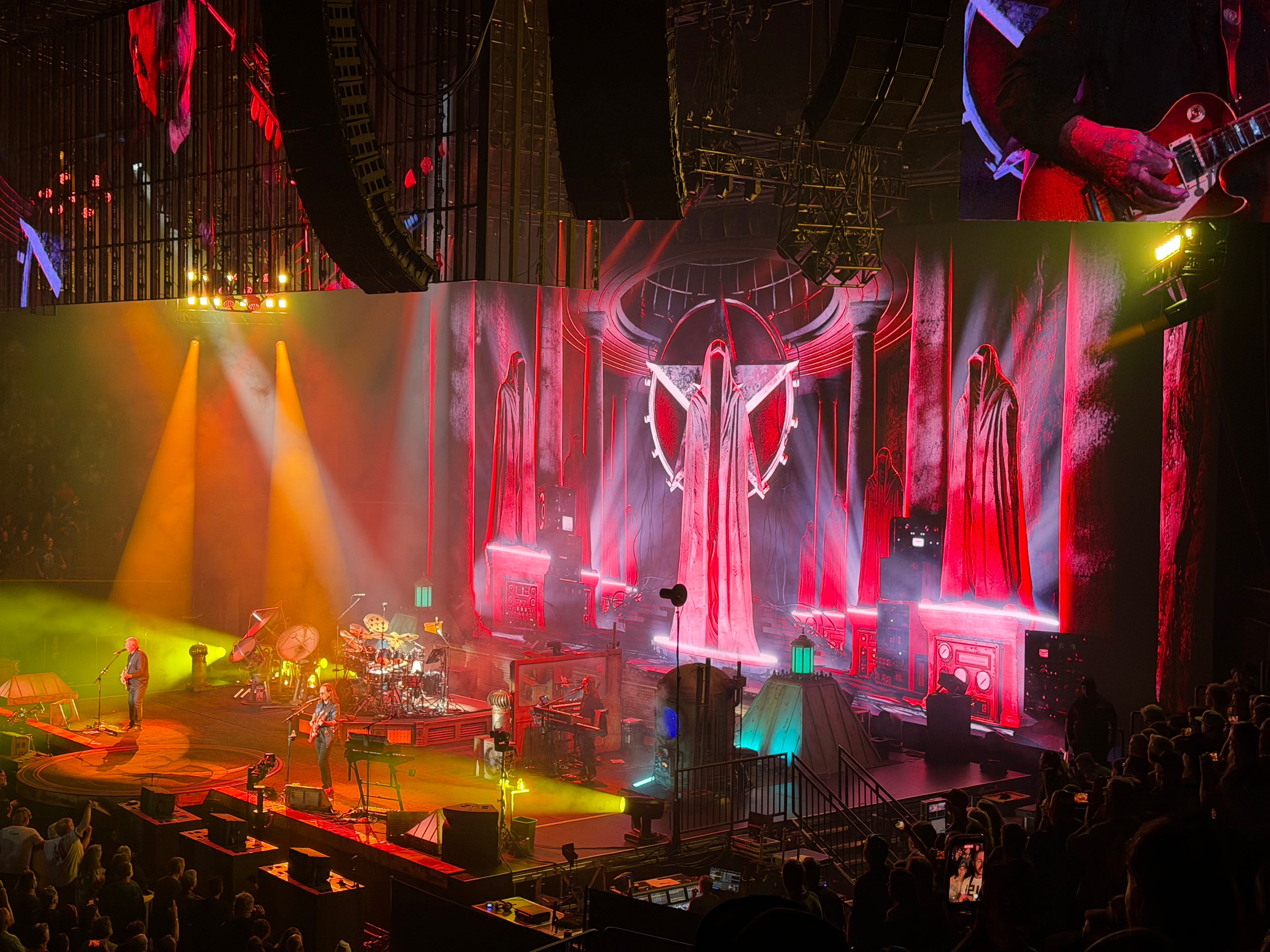
Geddy Lee and Alex Lifeson, boyhood friends and bassist and guitarist, respectively, of the Canadian progressive rock band, Rush, are 72.
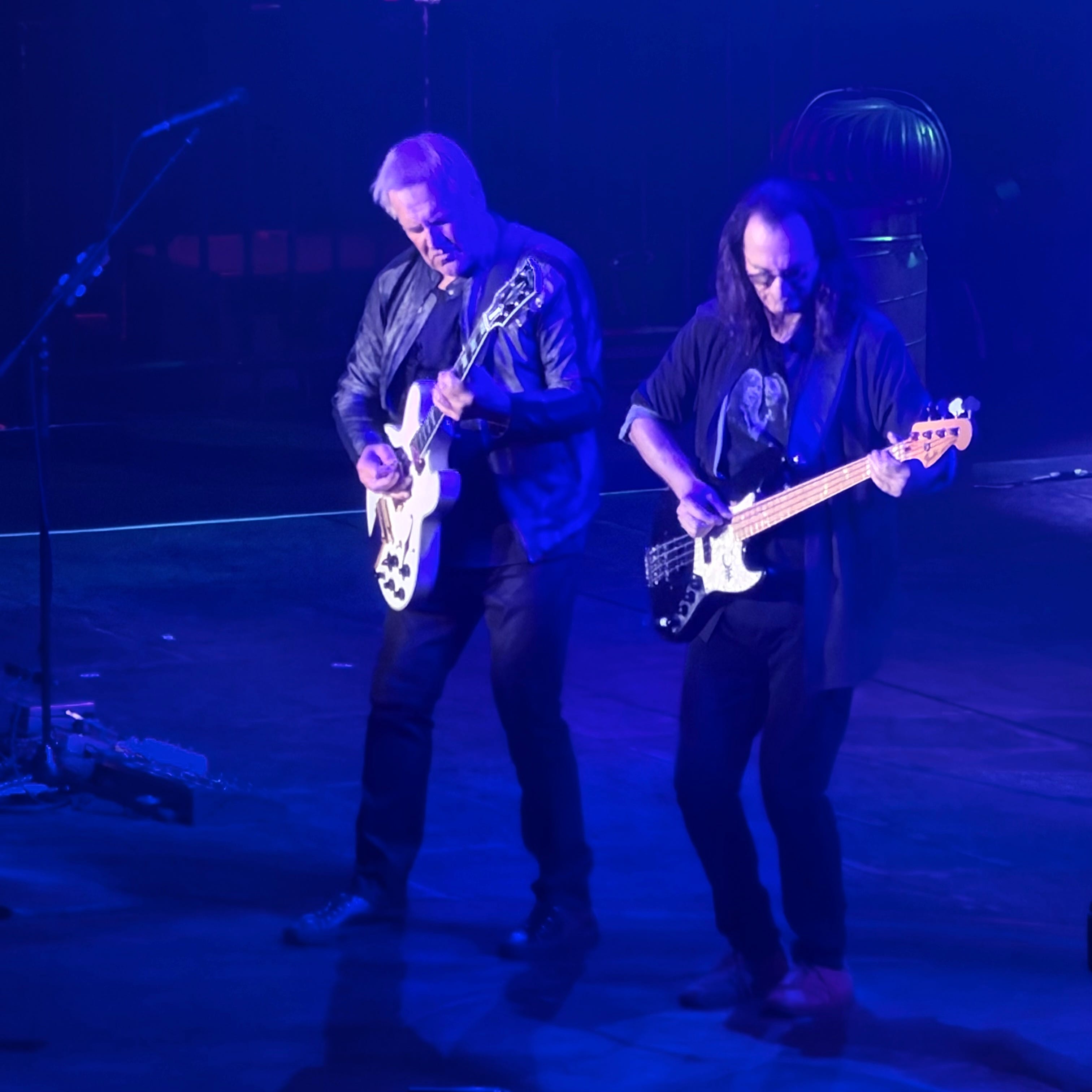
The band’s incomparable drummer and lyricist, Neil Peart, is gone, killed by brain cancer in 2020, but here were Lee and Lifeson, at the start of a projected 58-date, 29-city tour, Lee leaping and strutting and Lifeson striking guitar god attitudes as they wrung cascades and sheets and roaring rapids of notes out of their instruments, which have never had necks enough to convey the pair’s intricate yet spacious musical ideas.
Lee’s famous Plant-squared ululatory style, Malkmus-mocked1, has dropped a couple of notches over the years, from clarion-register clarinet to a mellower cor anglais. The pair, like Hockney, rely on craft, technology and practice, practice, practice to work around the challenges that youth barrels through.Ten years ago the band had retired, saying essentially that they, in particular Peart, were done. But last night those two surviving old dudes, clearly energized and buoyed by the presence at their backs of a ferociously meticulous 43-year-old German drummer named Anika Nilles, seemed ready to pick up not where they had left off but some time or place before that, somewhere nearer to their prime, closer to the heart.
My impression is that Hockney never went on any such extended hiatus from painting as he aged; that, on the contrary, increasingly he took a break from everything but the work. But then painting, like writing, and unlike rock guitar playing (pace Robert Fripp), is commonly done while seated, and involves relatively little in the way of Chuck Berry-style duckwalking or Pete Townshend-style windmilling or pounding on an array of paint can lids, hard and in time, for two solid hours.
Like Lee and Lifeson, however, Hockney remained fiercely open to new technologies, and to seeking inspiration and creative stimulus in the work and ideas of younger artists and collaborators; and maybe therein lies the secret of enduring creativity in one’s old age.
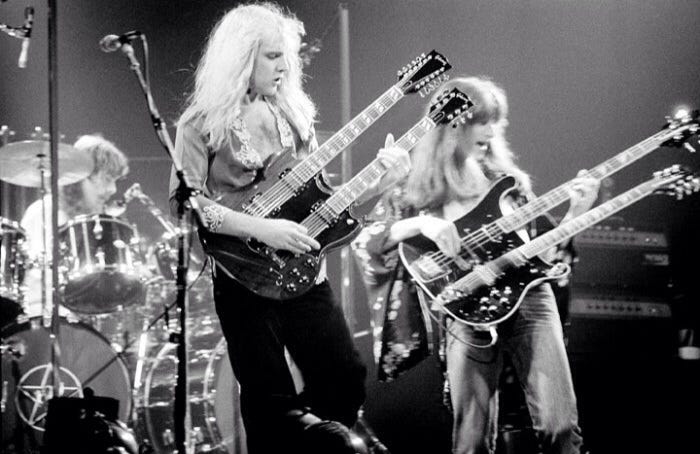
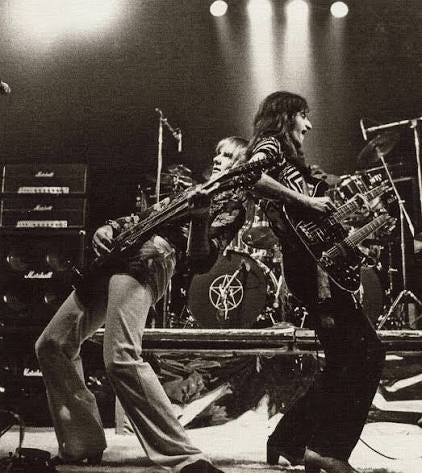
It’s become a kind of personal cliché with me to feel my heart squeeze a little whenever Lee and Lifeson, who met in grade 8 at Toronto’s Fisherville Junior High School, circa 1965-66, station themselves staunchly back to back on stage, enacting physically a lifetime of musical and emotional support, or whenever one of them simply leaves the other one—after so many gigs and rehearsals and years in the studio—grinning with astonishment at some lick or run.
But it was also unexpectedly moving, and beautiful, to watch the interplay between Rush’s old bassist and its new drummer, every time Lee wandered over to that skyline of drums, bells, and cymbals to check in with his battery-mate. Moving, because it was the habit of half a century, of more than two-thirds of his lifetime—the veteran engineer making the rounds, checking the dials, tapping the gauges, and because he still could not seem to fully grasp or get his head around the fact that the person in that city of drums, making all that organized noise, was not a stern, strapping, self-contained, stoic, intermittently mustached rock’n’roll philosopher but a slender young woman with a blond ponytail who visibly took pleasure—sometimes joyful, sometimes verging on impish—in holding fast to the sweet spot between atomic-clock precision and atom-bomb power.
You could see Lee, on the Jumbotron, marveling at that power and precision, and at the grit and guts and (justified) faith in her own talent Nilles had needed to dare replace the irreplaceable Peart. Marveling at all the changes that had taken place in his and the band’s life since 2020 and 2016 and 1980 and 1976. Marveling at the very fact of change itself. And then he would give Nilles one of those aforementioned astonished grins.
And beautiful, and moving, finally, because now as she picked up on what this old dude—one of the greatest rock bassists ever! Her battery-mate!—was throwing down, the young drummer grinned right back at him.
In “Stereo,” on Brighten the Corners (1997).
I'm so delighted that you got to witness the magic, and equally excited that I'll have the opportunity in late July in New York.
Live music is as close to religion as I get, as I find singing along with a crowd of thousands, united in purpose and simultaneously located in a precise moment of space and time that somehow stretches on into infinity inherently spiritual. And that's never more true than when the band is Rush--their longevity is a time machine in and of itself, each performance and note simultaneously an invocation of some higher power of creativity that harnesses the raw energy and evocation of each the moment and energy of performance past and yet to come.
In a world where we're increasingly disintermediated from experience, I can't wait to be in that moment again, in all those moments again, surrounded by people who just get it.
True artistry in any domain is an inspiration to artists of all domains. I frequently can't wait to get home and write after an amazing concert, art show, play, etc. (Same, of course, when I finish a great book, like, say, Kavalier & Clay. 😎)